
The Defense Advanced Research Projects Agency (DARPA) concluded its Lift Challenge last week, and although none of the participants achieved the desired goal of building a drone capable of lifting four times its weight, they came close.
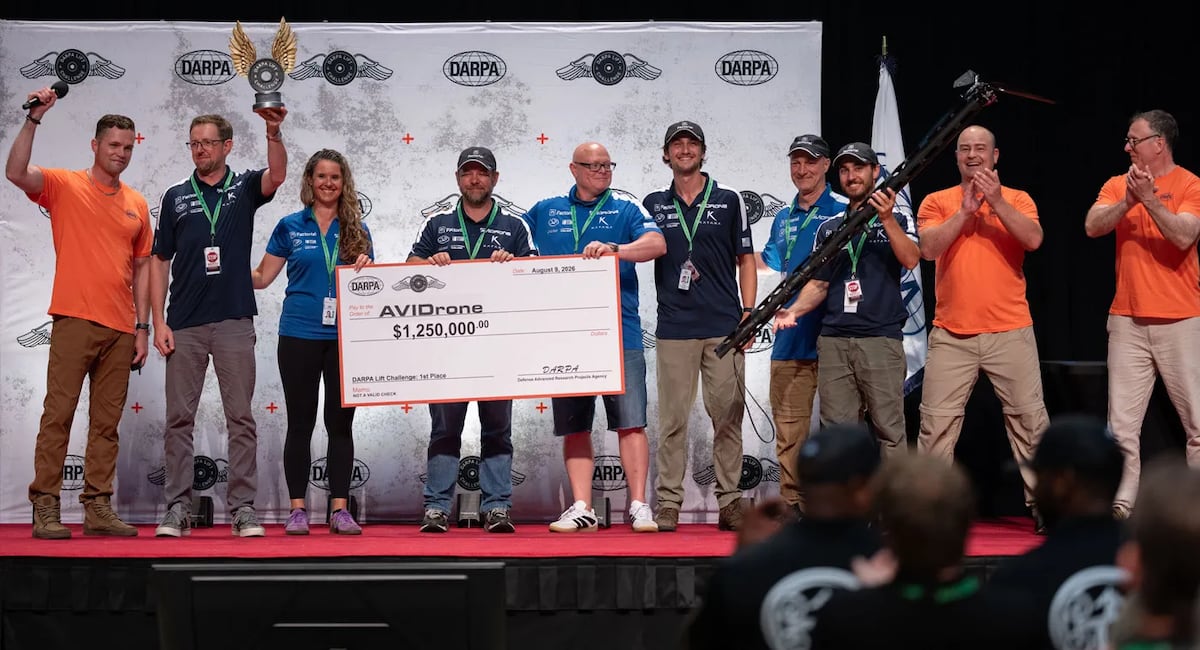
The agency announced that the company AVIDrone pushed the limits with its electric helicopter design that lifted an unprecedented payload-to-weight ratio of 3.84 to 1.
In practical terms, that means the company’s Katana heavy-lift drone, weighing 29.3 pounds, lifted and carried a payload weight of 112.4 pounds across approximately five nautical miles.
AVIDrone, a Canadian company with U.S. headquarters in Maryland, specializes in cargo delivery drones for the defense and commercial sectors.
In a statement, the company called its first-place performance the “result of bringing together years of know-how, our proprietary autopilot and flight-control technologies, and decades of experience designing and flying aircraft specifically for heavy cargo lift.”
With the DARPA Lift Challenge, the agency aimed to advance vertical lift in a small unmanned aerial system. Calling it the “heavy-lift bottleneck,” multirotor drones typically can only carry payloads equal to or less than their own weight.
Phillip “Donna” Smith, the Lift Challenge program manager, described heavy vertical flight as the “next great technological inflection point that is economical for widespread adoption.”
He explained that its application could revolutionize industries like agriculture, logistics, construction and more.
By placing first, AVIDrone won $1.25 million in prize money. But the company also described the competition as an “outstanding environment for accelerating new ideas and turning them into real-world applications.”
The second-place winner, Massachusetts-based MTech Operations, was awarded $750,000 for lifting 3.64 to 1; and the third-place winner, California-based Xtreme Aerial Concepts, was awarded $500,000 for lifting 3.45 to 1.
And then DARPA issued awards for subjective categories, which were determined by a panel of program managers with deep aviation expertise.
These included the University of Maryland team for the Most Revolutionary Aerodynamic Design, the Texas-based Portal Aircraft Company for the Most Revolutionary Powertrain Design, and the Utah-based DefendTex for the Most Promising Technology.
For the latter, DARPA said it had the highest ratio in the competition, with 9.63 to 1, but it did not complete a scored run.
Smith told Military Times that besides the prize money and the cool demonstrations, the Lift Challenge created a huge networking event that allowed inventors, investors and users to set new goals and create future projects.
“So now, the challenges can get organized and the community that is built can start moving and (try) to solve problems that different organizations have across the United States or even the world,” Smith said. “Like we’ve seen in past challenges, the people here oftentimes combine forces and build the next generation of aircraft or whatever the challenge is.”
Daniel Terrill is a contributor to Military Times. He’s been reporting on military issues, the gun industry, and the outdoors for nearly two decades. Although writing is his passion, he’s been a Marine, police officer, and, perhaps the most dangerous job of his career, a substitute teacher.
Read the full article here