

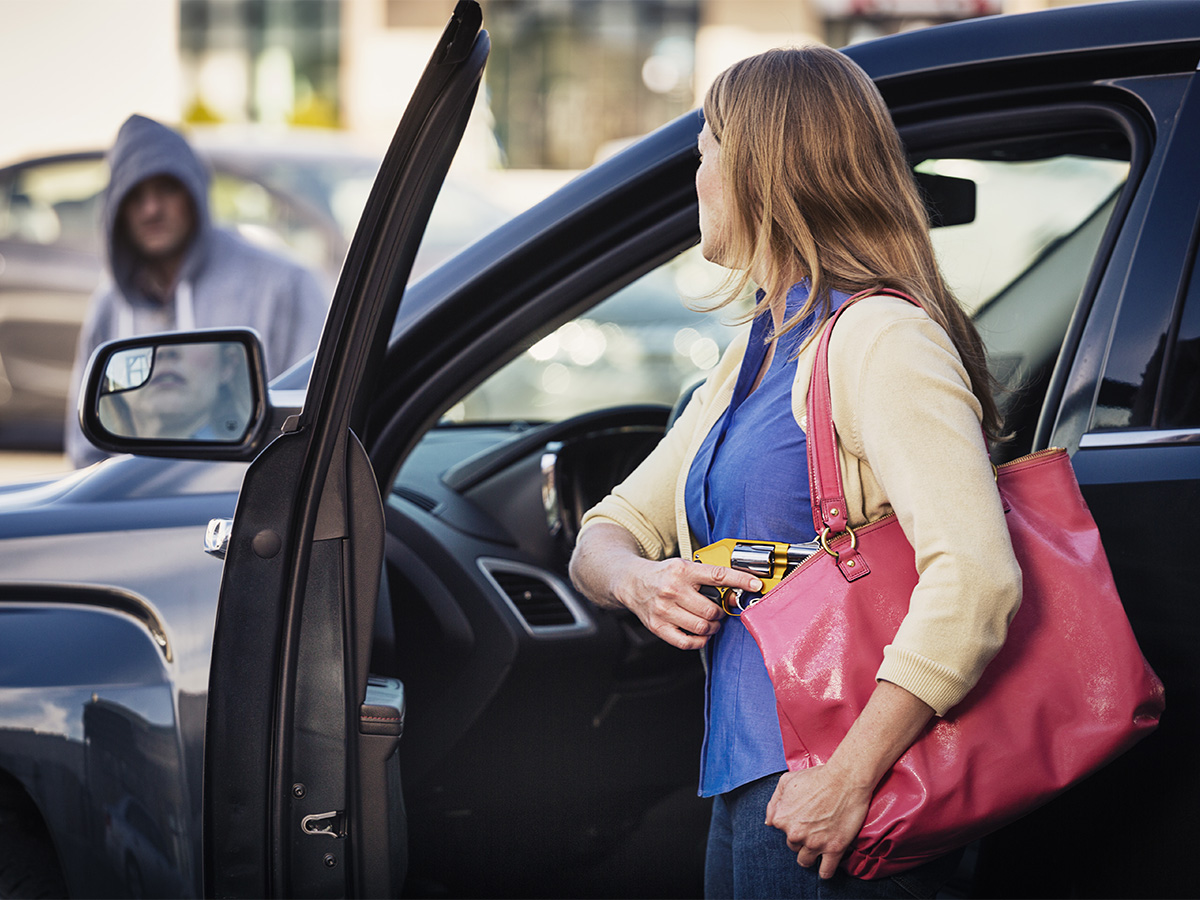
What are the odds that you’ll ever need to use a gun for self-defense? Here we break down the data.
A few months ago, John Correia of Active Self Protection was confronted by a burglar in his own home. The man fled, no shot was fired, and Correia walked away thinking about a question many armed citizens eventually ask. Realistically, what are the odds I will ever need my gun? In a video on his channel, he ran the numbers from two major firearms surveys and arrived at a startlingly large lifetime probability. This article borrows his framework and pushes further into the underlying data.
The starting point is the 2021 National Firearms Survey, conducted by Georgetown professor William English. English polled more than 54,000 Americans, identified nearly 16,700 gun owners, and asked them in detail about defensive gun use. His headline estimate was that civilians use firearms defensively about 1.67 million times a year, and in 81.9 percent of those incidents no shot is fired, since the mere presence or display of the firearm is enough to end the threat. Handguns account for two-thirds of defensive uses, and the large majority happen on the owner’s own property rather than in public. A quarter occur inside the home itself, and more than half take place elsewhere on the property. Just over half of all defensive incidents, English found, involved more than one assailant.
Compare that to the Bureau of Justice Statistics’ National Crime Victimization Survey, the federal government’s primary measure of crime. For 2021, BJS estimated 326,890 violent victimizations in which the offender possessed, displayed or used a firearm, about 7 percent of all violent victimizations that year, with nearly three-quarters reported to police. Set the two figures side by side and defensive gun uses outnumber criminal firearm victimizations by more than five to one.
That comparison alone is provocative, but the more interesting exercise is converting it into personal odds. English’s survey found that 31.9 percent of U.S. adults personally own a firearm, a figure that lines up closely with Gallup’s most recent polling, which showed 30 percent personal ownership and 42 percent household ownership in late 2025, numbers that have stayed within a fairly narrow band for the better part of two decades. Apply roughly 32 percent personal ownership and 40 percent household ownership to a U.S. adult population of about 268 million, and the result is something like 86 million personal owners and 107 million adults living in a gun-owning household.
Small Numbers Add Up
Divide English’s 1.67 million annual defensive gun uses across those populations and the annual odds look modest, about 1.9 percent for a personal owner and about 1.6 percent for someone in a gun-owning household. Small annual numbers compound, though. Assume a 60-year span of ownership, from age 20 to 80, and treat the annual risk as constant. Run that through the standard formula for cumulative probability, and the personal-owner figure becomes a roughly 70 percent lifetime chance of a defensive gun use. For gun households, it works out to about 61 percent. Restrict the calculation to incidents where a shot is actually fired, which English puts at roughly 300,000 a year, and the lifetime odds fall into the high teens, about 19 percent for personal owners and about 15 percent for gun households. Either way, the arithmetic says a defensive gun use, broadly defined, is more likely than not to touch a lifelong owner’s household at some point.
None of this is uncontested. English’s survey drew serious scrutiny in a 2024 critique from a group of Harvard and Duke researchers led by Deborah Azrael, who challenged his methodology on several fronts, including how the survey defined “assault weapon” ownership and an odd age distribution among reported defensive gun users. Firearms researcher David Kopel refereed that exchange for the Volokh Conspiracy in 2025, and after working through both sides point by point, concluded that English’s defensive-gun-use estimate “is credible, if one believes that DGUs can be measured at all,” a fair summary of where the broader research landscape sits.
The 1.67 million figure also falls comfortably within the range established by earlier work from criminologists Gary Kleck and Marc Gertz, which estimated 2.1 to 2.5 million annual defensive gun uses back in 1995, when violent crime rates were considerably higher than today’s. The NCVS, by contrast, was never designed to measure defensive gun use directly. It only captures the behavior when someone who has already identified as a crime victim volunteers it in an open-ended follow-up question, which is the chief reason it produces such a different number than purpose-built surveys do.
Both Sides of the Coin
A complete accounting of firearm risk must include the other side of the ledger: suicide. According to the CDC, as compiled by Pew Research Center, 44,447 Americans died from gun-related injuries in 2024, the fifth-highest annual total on record. Sixty-two percent of those deaths, 27,593, were suicides, a near-record rate, while 35 percent, 15,364, were homicides, down 27 percent from the pandemic-era peak in 2021.
Measured against the same gun-household population used above, the annual probability of a firearm suicide works out to roughly 0.026 percent, meaning the annual odds of a defensive gun use in that same household run on the order of 60 times higher than the odds of a completed firearm suicide. That ratio does not make any individual suicide less tragic, and it does not substitute for responsible gun ownership: secure storage, removing firearm access for anyone showing warning signs, and treating “no unauthorized access” as a non-negotiable rule of ownership. But it does put the relative scale of the two risks into perspective.
None of this is offered as a test of whether the right to keep and bear arms depends on probability. It does not. The Second Amendment does not condition an individual’s right to self-defense on a government survey or an actuarial table showing the need is “likely enough.” Rights are not privileges granted by the state or validated by social-science data. They are recognized as already existing. The figures above answer a narrower, practical question. How often does real-world experience show a firearm actually gets called on in defense, and how does that compare with the other risks of ownership? Readers remain free to weigh that calculus, or set it aside entirely, when deciding what role armed self-defense plays in their own life. The right itself rests on separate grounds.
Whether to own a firearm at all is a separate question from the ones examined here, and the figures above don’t answer it. That calculation depends on training, discipline, household composition, and individual risk tolerance, not a probability table, and it sits alongside other reasons people own guns, from hunting and competition to simple recreation. What the data does support is Correia’s underlying point. Framed across a lifetime rather than a single year, the likelihood that a trained, responsible gun owner will eventually need that firearm for defense is not a fringe scenario. It is closer to a coin flip than a longshot.
Editor’s Note: This article originally appeared in the September 2026 issue of Gun Digest the Magazine.
More Knowledge For The Armed Citizen
Read the full article here