
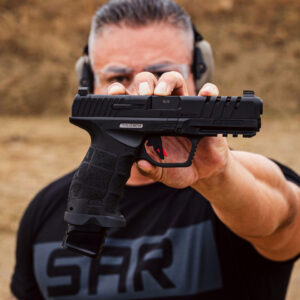

In combat, suppressors on a personal weapon can mitigate noise and muzzle flash, offering a critical stealth advantage against the enemy. But for the service member–typically a special operator–behind the weapon, firing suppressed can mean being on the receiving end of a concentrated stream of toxic gases and particulate matter.
As efforts to recognize and address the lesser-known side effects of military training, from mild traumatic brain injuries to hearing loss, have increasingly gone mainstream, some advocates are raising the call to target damage from suppressors as well.
The veteran-led group Special Operations Association of America (SOAA) published an article earlier this year airing some findings about the health impacts of aerosolized gases and metal fragments that wash over an operator when a gun with a conventional suppressor is fired.
According to Dr. Chris Palmer, a former Pentagon official and chief scientist for the suppressor company HUXWRX Safety Co., they can include long-term conditions ranging from decreased sperm motility and deformities to sleep disorders, Parkinson’s disease, and Bradykinesia, or slowed movement.
Operators who spoke with SOAA attested to the physical sensation of suppressor blowback, calling it “a thick grime or dust that covers your head, face, neck, and hands, and even gets in your mouth … it can’t be good for us.”
Palmer told Military Times he completed a literature review of more than 100 studies looking at the effects of gunfire and exposure to the hydrogen cyanide and ammonia that are its byproducts.
He contends that the concentration of these substances and their forceful ejection back into the faces of operators, particularly in enclosed environments, mean the effects of exposure are compounded, delivering doses much higher than levels deemed acceptable by EPA and industry guidelines.
“If we have people getting much lower doses and having poor health outcomes, I feel I can take the scientific leap and say, Hey, we know that the dose of this compound on the human system comes out with these kinds of bad, negative effects. We know that [Special Operations Forces] operators and people who shoot every week have much higher doses of these compounds … if these things happen at a lower dose to the average person, I can say that this compound definitely contributes to those kind of outcomes in SOF, while noting that our guys and gals are exposed to a lot more,” Palmer said.
HUXWRX sells a patented suppressor system that it claims redirects toxic gases through a series of coils, and it also conducts tests on its gear using an airtight box to measure gas emissions.
It’s not the only company addressing the issue—Sig Sauer also markets a suppressor engineered to reduce blowback. Toxic blowback also forced a 2024 parts redesign in the development of the Army’s Next-Generation Squad Weapon, also made by Sig Sauer.
Ryan Ziegler, chief of veteran health and research for SOAA, said the organization isn’t endorsing a specific brand or product. Ziegler, a Green Beret who served as a Special Forces medic and then earned his commission, said he had personal experience with health concerns related to toxic blowback from his time as a unit executive officer.
“I would get phone calls from guys when they’re in training environments or overseas,” he said, recalling reports of nausea and headaches after a few days of heavy shooting in enclosed spaces.
While it was difficult to conclusively determine in cases like those whether symptoms stemmed from traumatic brain injury due to overpressure, some other pollutant like blasts from door charges, or toxic blowback from suppressed weapons, Ziegler said the evidence was concerning–and fit into a larger pattern of medical issues that disproportionately affect the special operations community.
SOCOM studies have documented what Ziegler described as a “constellation of symptoms” that hit special operations harder than the conventional military, from headaches and neurobehavioral symptoms to suicidality and various kinds of cancer.
“We have a unique set of issues … when we look at what exposures are different for us in training and in combat than a conventional force that would cause these things, it’s hard,” Ziegler said. “We can’t just point to one thing.”
The recently passed House version of the National Defense Authorization Act for Fiscal Year 2027 would include $5 million to purchase blast overpressure mitigation devices for small and medium-caliber weapons. It would also launch a pilot program to test the effectiveness of these devices and establish a “Blast Overpressure Task Force” at the Department of Veterans Affairs to develop treatments. The bill has not yet been finalized; the Senate must still pass its version before the bill can undergo the conference process.
Ziegler would like to see similar policy treatment for suppressor blowback concerns.
“[The Pentagon] already has the machinery, congressionally mandated blast overpressure studies in quantified weapon system blast effects on brain and auditory health inform risk mitigation and acquisition policy,” he said. “So, toxic blowback belongs inside that same acquisition and monitoring framework, and not treated as a separate issue.”
Palmer said HUXWRX, which has secured several significant federal contracts, including with the FBI’s Hostage Rescue Team, is hearing increasingly from military customers curious about what it would take to retrofit weapons with safer suppressors. He’s hopeful that toxin-reducing suppressors will soon become a military standard.
“Our job is to make it as safe as we can,” he said. “We’re not here to pretend that they’re going to get no fumes and they’re going to get no exposure. Our job is to get them as much decrement in that exposure as we can without giving up operational capability.”
Read the full article here