

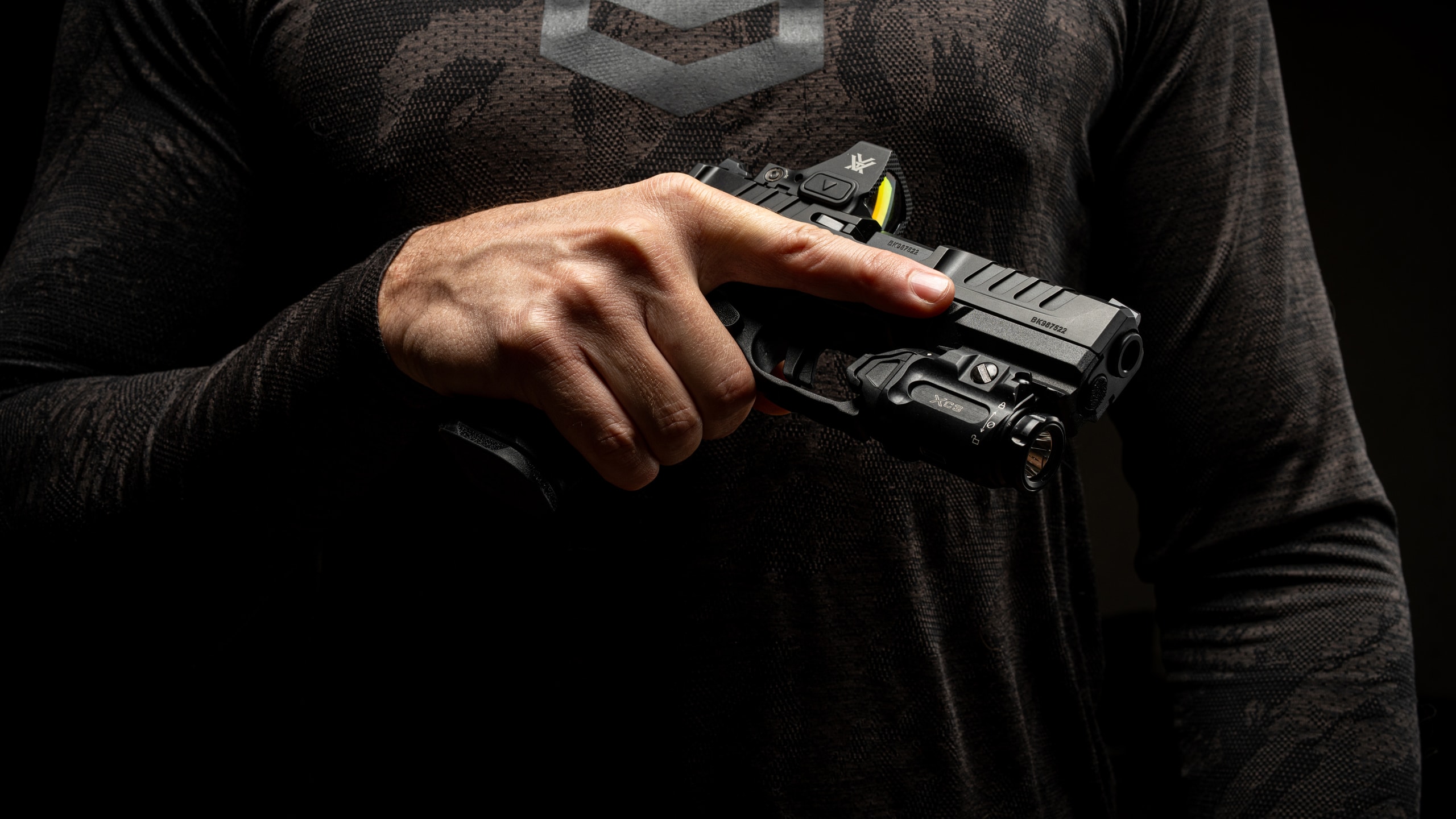
Perhaps it’s a consequence of growing up in a consumerist society, but most of us become in some way conditioned to think that upon encountering any problem, our first and best course of action is to buy something to deal with it. Don’t get me wrong — a high-quality firearm and accessories are absolute musts for effective self-defense. However, they are not the only part of the equation.
Where the shooting sports are concerned, the market is now filled with a number of admittedly excellent products that solve clear problems and smooth over historical pain points. Chronographs are easier to use, more accurate, and more reliable than ever before. Optics manufacturers continue to provide consumers better clarity at higher magnifications at lower prices. And, at even a low-tech level, my range bag is never without an UpLula magazine loader.
I would go so far as to say that the presence of a red dot sight (RDS) is probably one of the single biggest features that differentiates a “modern” firearm from a “vintage” one. Far from just another gadget, an RDS avails itself to the user in a great number of ways, making it a mainstay for soldiers, law enforcement officers, and competitive marksmen.

That said, I find a troubling number of lay shooters are buying it to address a problem it is utterly incapable of solving.
What the Dot is Good For…
Let’s start with the unquestionable benefits of this optic choice. First, in both daylight and under the cover of night, the user never needs to worry about going without a clear aiming point. If you have an iron-sighted handgun or long gun around, wait until the sun goes down and turn off all of the lights in your house. Then, see whether you’re able to obtain a usable sight picture. If you haven’t conducted this experiment yet, you might be surprised by the limitations of what you formerly considered a “good enough” home defense system.
A user could of course solve this problem with a weapon-mounted light or other form of illumination. This is a choice that works for many; however, there may be situations where you don’t want to reveal your presence in a manner that is so figuratively and literally glaring. Mark another point for the RDS.

A dot sight also allows for extreme simplification; if properly adjusted, and within “across the room” distances, where the dot goes is where the bullet will go. Though I’ve never myself been mystified by how iron sights work, I have taught enough people to see where keeping three objects in alignment — that is, rear notch, front sight, and target — sometimes presents problems. Even novice shooters intuitively understand what a RDS asks of them, and as such streamlines the instruction process.
Speaking of alignment and focus, my friend and fellow shooter Ron opened my eyes a bit when he told me why all of his firearms are equipped with a dot sight. As an officer with the LAPD, Ron says that the RDS on his duty weapon allows him to maintain his sole focus on a suspect, not a front sight post.

Indeed, every bit of visual acuity is welcome when it comes to making sure someone’s hands or waistband is empty; consider how many professional contexts exist where a “slightly blurry” target would be too big of a liability to accept. (For some more thoughts on this phenomenon, readers may find Michael Mills’ article on “threat focused” shooting to be a worthwhile read.)
The Problem the Dot Can’t Solve
I like red dot sights for all of the reasons provided above. However, in talking to most beginning and intermediate shooters, their number one reason for buying a red dot sight is because they believe it will make them more accurate.

Let me state this for the record: a dot sight does give the user a clear and intuitive sight picture. It absolutely will not help that user if — through whatever process of recoil anticipation, poor manipulation of the trigger, or through any gremlins of grip and stance — they yank the dot off target. This is, in nine cases out of 10, exactly what’s happening when a shot goes wide.
Shooting is hard; handgun shooting even more so. Instead of searching within for answers, most human beings have a strong tendency to look for external forces at play whenever life deals them a bad hand. For a great number of shooters who end up with pizza-sized groupings at relatively short ranges, you’ll often see them blaming the gun. A similar excuse is not far behind: “I think the sights are off.”

Live The Armory Life. The latest content straight to your inbox plus an automatic entry to each of our monthly gun giveaways!
Admittedly, the rest of us probably don’t help the situation. As these users walk up and down the shooting bays and take note of what “the pros” seem to be using, they’re going to notice a lot of dot sights and optics. Their brain thus connects the dots (pun intended) in a way that maximizes self-protection and ego.
“So that’s what they’re using to print those tiny groups,” they think. “If I only buy the same gear, my inaccuracy will be solved!”
Addressing a Different Culprit
To this day, I am perpetually surprised by how secondary a perfect sight picture is to perfect trigger control. Especially at ranges of less than 50 feet, if you’ve pulled the trigger perfectly, even a “good enough” iron sight picture will result in a center-punched hit.

I’ve written more for The Armory Life about the process of mastering a trigger pull through dry-fire, which I invite readers to explore here. To condense those thoughts, however, I will say that there are really two components to addressing the inaccuracy that too many shooters blame on the sights.
First, at-home dry fire practice is absolutely necessary to ingrain the tactile and kinetic knowledge of how to pull the trigger without disturbing the sights. A gun held perfectly still when the hammer or striker drops is one that will place rounds where they are intended to go. Second, at the range, “snap caps” are an invaluable tool: they provide instant reinforcement to a shooter that a trigger is not being pulled correctly, and indicate that immediate work is needed to re-train the body out of a pre-ignition flinch or mash.

For the purposes of our discussion, this is also the single best way to get a shooter to understand that the red dot sight (or their original iron sight system) is absolutely not to be blamed for any unacceptable or disappointing groups. Until shooters experience this pivotal insight, it’s very likely they’ll still be tinkering with their equipment in a misguided quest to improve.
Caveats and Final Thoughts
Are there some cases where a dot sight can make a shooter more accurate? Certainly. On subcompact pistols, an RDS makes contending with a short sight radius a non-issue. A circular dot may also allow for a more consistent and repeatable sight picture, especially where the front post of an iron sighted system might block some part of the target.

These kinds of considerations, however, may allow a shooter to turn a 4” group at 25 yards with a handgun into a 3” group, or transform a 2” group at 50 yards with a rifle into half that size. Sadly, even the best optic system will not convert wildly errant rounds into bullseyes.
As I recently heard someone so wisely phrase it, you can’t solve a software problem with a hardware change. The dot sight provides us with a tremendous number of benefits, and for those who rely on their firearms in the direst of situations, there’s simply no replacement for them. However, and at least at the time of my writing, it still takes an extraordinary amount of practice to make one’s bullet go exactly where the dot is.
Editor’s Note: Be sure to check out The Armory Life Forum, where you can comment about our daily articles, as well as just talk guns and gear. Click the “Go To Forum Thread” link below to jump in!
Join the Discussion
Read the full article here