
Shrouded in myth and pride, the conception of the Revolutionary War is of redcoats marching stiffly through fields and woods while being picked off by wily colonists hiding behind trees, all to the tune of Johnny Horton’s “The Battle of New Orleans” (“we fired our guns, and the British kept a-coming”).
But as America celebrates the 250th anniversary of the Declaration of Independence, it is easy to forget that independence was not guaranteed. As they shivered at Valley Forge in the winter of 1778, George Washington and his troops would have scoffed at the notion that victory would come on a silver platter.
For the American Revolution to succeed, the colonists had to create an army. Whether the Continental Army was defeated on the battlefield — as it frequently was — mattered less. As long as the United Colonies could keep an army in the field, Britain would be forced to continue what seemed like a forever war.
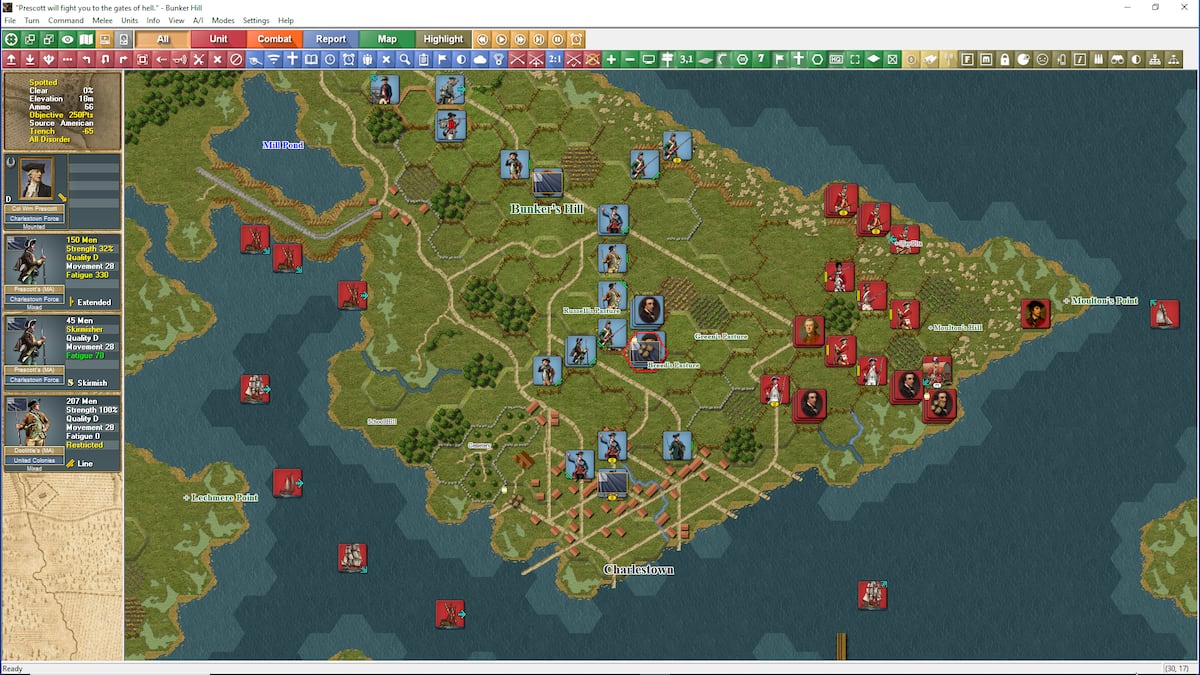
“American Revolutionary War” is a computer wargame that depicts the battles of the American Revolution, or what the British call the War of American Independence.
With 148 scenarios, from small engagements like Hubbardton and Kettle Creek, to larger battles such as Princeton, Brandywine and Saratoga, American Revolutionary War is part of publisher Wargame Design Studio’s Musket & Pike series. These games depict warfare from the 15th through the 18th Centuries, an era where polearms were gradually replaced by gunpowder weapons, such as muskets.
By the 1770s, the pike had been replaced by the bayonet, and the primitive arquebus by more reliable flintlock muskets including Britain’s “Brown Bess.”
With a 114-page user manual, American Revolutionary War is not exactly casual entertainment. It is a highly detailed simulation not just of 18th Century European-style warfare — but also how difficult it was to conduct armies’ European-style warfare in the 18th Century North American wilderness.
The game depicts battles at the grand tactical scale, with battalions and companies of infantry, as well as batteries of artillery and the occasional horse soldier (cavalry was much rarer than the later Napoleonic and American Civil Wars). The American have Continental regulars and local militia, while the Crown fields a polyglot force of British regulars, German mercenaries, Loyalist troops and Native American allies.
These units maneuver across a 2-D hex-grid map of eastern North America in its pre-industrial glory. The terrain is studded with forests, fields, marshes and streams.
Units are rated for how many troops or guns they have, and their weaponry (musket, 3-pounder artillery, etc.). Most important is a quality rating from A to F, which affects combat proficiency and movement. The British regulars tend to be quality As and Bs, while the Continentals tend to be Cs and Ds, and the American militias Fs.
Players alternate taking their turns, with each turn representing about 15 minutes of real time. Each player conducts movement and fire combat, followed by a melee phase to resolve assaults. Combat inflicts casualties as well as “fatigue,” which saps morale and effectiveness until units break or rout.
Western battlefield tactics in the 18th and 19th Centuries centered on assuming the right formation in an era when troops fought shoulder to shoulder. Column formation was used to expedite movement, though at the cost of firepower and presenting a juicy target. When engaging in a firefight, infantry would assume line formation, standing in two or three ranks.
Units in line that move through rough terrain, or obstructions, such as walls, run the risk of becoming “disordered,” with movement and fire penalties. On the other hand, a densely packed column can take heavy casualties from enemy troops deployed in line. Dispersing troops into open order makes them less vulnerable to enemy fire, but penalizes them in melee.
One myth is that the conflict “was fought by the British in a strictly linear fashion, while the Americans were primarily in skirmish,” Mike Cox, designer of American Revolutionary War, told Military Times. Both sides were capable of assuming a variety of formations, though this presented challenges for under-trained Continentals.
“The Americans often tried to fight linearly, too,” added Cox. “It just didn’t often work out well.”
Particularly useful are the detachments of light infantry.
“Learning to master your light troops is extremely important,” Cox said. “When to deploy as skirmishers to delay or scout, or recall and use them to effectively melee to push back the enemy and take and hold ground.”
Command and control has always been the glue that binds armies, but especially so in the pre-radio era, when commanders personally led their troops.
American Revolutionary War features historical commanders, rated from A (George Washington) to F, that form chains of command in each army. Leaders can rally broken troops and provide morale bonuses, though they can also be felled by enemy fire.
“Keeping units in range of their leader and their leader in range of the next higher echelon makes an army work well,” Cox explained. American commanders will need to stay close to their militia: “Keeping them in command and preventing their disruption and breakdown is an art.”
One fascination of playing historical wargames is seeing how they model the little things. For example, the British Army’s Scottish Highlanders are given a bonus during melee combat “to reflect their impact on the minds of American troops, and their reputation for relishing close combat,” the game manual notes.
But ultimately, the question comes down to: How accurately does the game depict the battles that determined the fate of the American Revolution? And, how well does it capture the essences of a professional army versus a more amateur — but also more inspired — citizen army?
American Revolutionary War fares well on both questions.
The unit quality, morale and command systems model the capabilities of both sides, including how the Continental Army improved over time due to combat experience, as well as the tutelage of European instructors like Baron von Steuben.
“British forces are often outnumbered,” said Cox. “They need to learn to stretch their lines or get outflanked. They will usually have some high-quality troops and have the advantage of picking the point of attack.”
“The Americans usually have a high number of units. However, quality and strength can vary wildly. The Americans need to know when to give ground and when to hit hard.”
Perhaps what is most striking is the theater of war.
WDS has published almost 120 historical wargames that cover gigantic battles, such as Waterloo, Gettysburg, Kursk and the Battle of the Bulge. In these games, the maps are packed with masses of troops.
In American Revolutionary War, the maps are often big, while the armies are small. One can begin to appreciate how British soldiers and colonial settlers must have felt about fighting in a vast, untamed land.
As Americans mark the Declaration of Independence, this is a reminder of how far our nation has come.
Michael Peck is a correspondent for Defense News and a columnist for the Center for European Policy Analysis. He holds an M.A. in political science from Rutgers University. Find him at theuncommondefense.com. His email is mikedefense1@gmail.com.
Read the full article here