

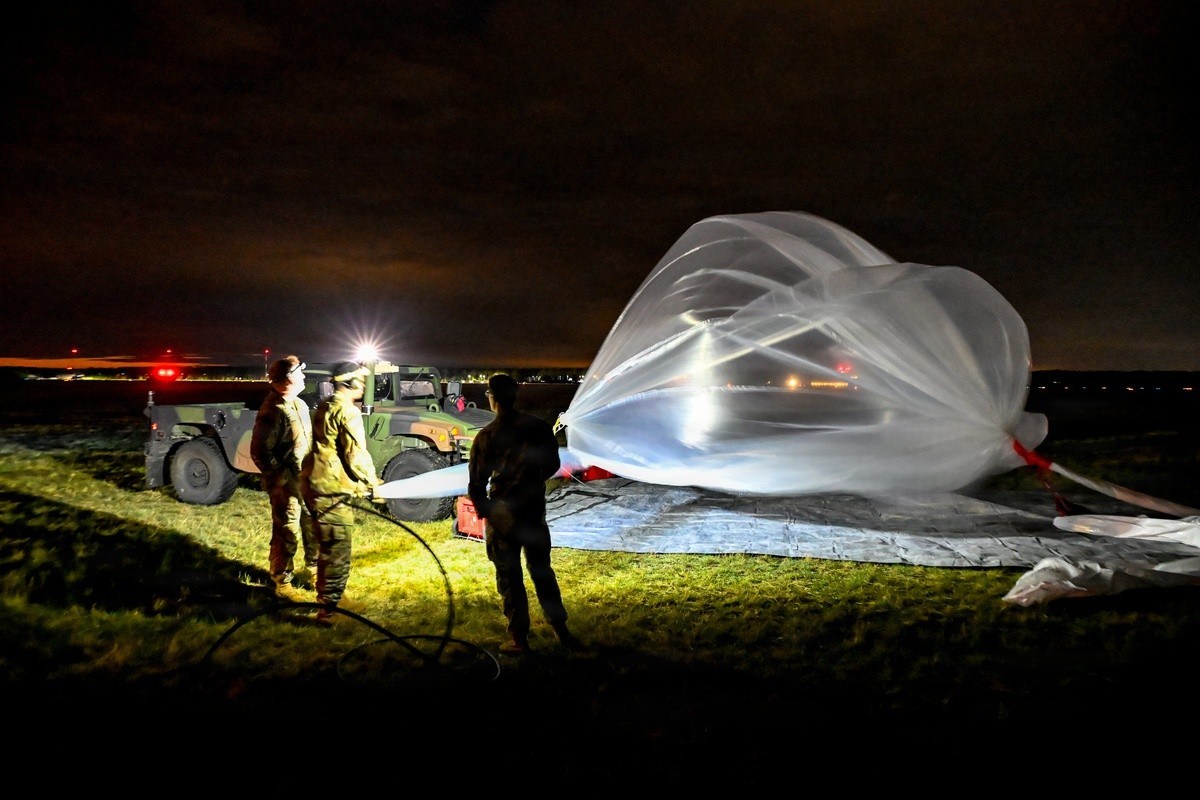
To burst China’s anti-access/area-denial bubble, the U.S. Army is looking at using high-flying balloons with payloads that can monitor the battlefield, relay communications and strike adversaries.
The Army has tinkered with high-altitude balloons for some time, but interest and experimentation have grown in recent years. Against China’s growing arsenal in the vastness of the Pacific, those balloons could provide a cheaper, lower-signature platform that can be employed from dispersed positions, Maj. Gen. Bernard Harrington, commander of the Army’s 7th Infantry Division/Multi-Domain Command-Pacific, or MDC-P, said at the Association of the U.S. Army’s annual conference in Washington, D.C., earlier this month.
Harrington’s command was recently established to merge the ground-maneuver elements of the 7th Infantry Division and long-range capabilities of the 1st Multi-Domain Task Force. Part of the unit’s mission is to operate in space, cyberspace and the electromagnetic spectrum and use long-range fires to help the rest of the Joint Force maneuver, including by opening gaps in China’s anti-access/area-denial network — the air, sea and land-based sensors and weapons designed to keep U.S. forces at bay.
“For us in the Pacific, we really are looking at a specific pacing threat and an anti-access/area-denial network,” against which MDC-P aims to create “windows of opportunity for that Joint Force, whether it be a carrier strike group that’s going to pulse into the weapons engagement zone, whether it be a bomber task force, whether it be a ground unit doing a joint forcible-entry operation,” Harrington said.
High-altitude balloons, or HABs, could facilitate that by carrying “launched effects” — the Army’s term for an aerial system deployed from crewed and uncrewed vehicles for reconnaissance, communications, strikes and other missions. HABs would give MDC-P soldiers more ways to employ attack drones and munitions that are cheaper than “exquisite” missiles, available in greater numbers and harder for adversaries to spot.
Interest in HABs has grown in part due to technological improvements that allow them to stay aloft for weeks or months at a time and give operators more control over where they go. That enhances balloons’ value as platforms for radars and other sensors which, at operating altitudes above 60,000 feet, can see far into rival territory while remaining in international airspace. They also offer a cost-effective complement to satellites, which are more expensive and whose orbits limit their time over any one area.
Harrington described high-altitude balloons as part of “an ecosystem” of data-collecting assets in space, in the air, on land and at sea. HABs in particular could compensate if space-based assets are taken out, Harrington said. “So our ability to employ HABs [and] have HABs be persistent enables both our collection and targeting as well as us [to] provide that information to the Joint Force for their collection and targeting.”
Harrington also described a role for balloon- or unmanned surface vessel-launched effects in kinetic strikes. With the right timing and enough precision, those strikes may not even need to eliminate their target to create an opening.
“Maybe I don’t necessarily need to sink a ship, but if I take out certain systems on that vessel, well, then it creates this temporal window of opportunity,” Harrington said.
“We saw great value [in] that maybe I don’t have to use specifically or unmask an exquisite system to achieve that effect. If I can achieve effect of mass utilizing lower-cost systems, maybe that will get me there,” Harrington added. “So we modeled that, and what we saw was — particularly with our unmanned surface vessels, long-range one-way attack, long-range launched effects — the ability to synchronize and mass that could potentially get us to achieve that effect.”
Harrington’s command experimented with some of those systems during Bayonet Quest 26, an exercise held in Michigan and on Lake Huron from late September to early October. An official video showed soldiers working with air and maritime drones, including a quadcopter launched from a surface vessel and a fixed-wing drone hooked up to a balloon. Harrington said Bayonet Quest tested MDC-P’s ability to “orchestrate those systems” by launching them, gathering data from their sensors, and using AI and LLMs to process that data and produce tasking orders.
“If you see [a potential target], then task a UAS to be able to come over and actually validate if that meets the target folder,” Harrington said, describing the approach. “Then I can task long-range one-way attack [or] an attack USV to be able to achieve that effect or I could send that as a potential fire mission to a more exquisite munition to be able to close that kill chain.”
That reduces the need for a large, easily targetable ground presence, Harrington added: “This is all about integration: Integrate multiple systems into one data layer, be able to lay something like a large language model on top of it, and allow orchestration so we don’t have a lot of soldiers in fixed sites on ground control stations.”
Harrington’s comments come amid a flurry of HAB-related experiments by the Army in North Africa, the Middle East, Europe and the Pacific.
At exercise Valiant Shield in Guam this summer, soldiers experimented with HABs and launched effects “within an island-chain operational construct.” One test sent a HAB aloft towing a long-endurance drone “to evaluate stratospheric payload deployment capabilities.” Soldiers tested the same balloon-drone combo in Japan during Orient Shield in September.
The Army’s Multi-Domain Command-Europe has done dozens of HAB launches over the past year to examine the logistics of employing balloons and to test sensing and communications capabilities using “experimental payloads.”
Speaking alongside Harrington this month, MDC-E commander Brig. Gen. Steven Carpenter said HABs have a role, alongside other sensors and weapons, in opening “windows of opportunity” against anti-access/area-denial networks, in particular by providing resilient communications and additional strike platforms.
“We like to proliferate the stratosphere with high-altitude balloons, but I mean 200, 300 at a time. We like to use them as drones, [communications retransmission], electromagnetic sensing, electronic attack, and then to drop them down and have air-launched effects,” Carpenter said. “During different seasons, the flight paths are different. We study that. We understand during what seasons, where the best places are to launch those high-altitude systems and then, again, to hold enemy cities and capabilities at risk at any time.”
Read the full article here